
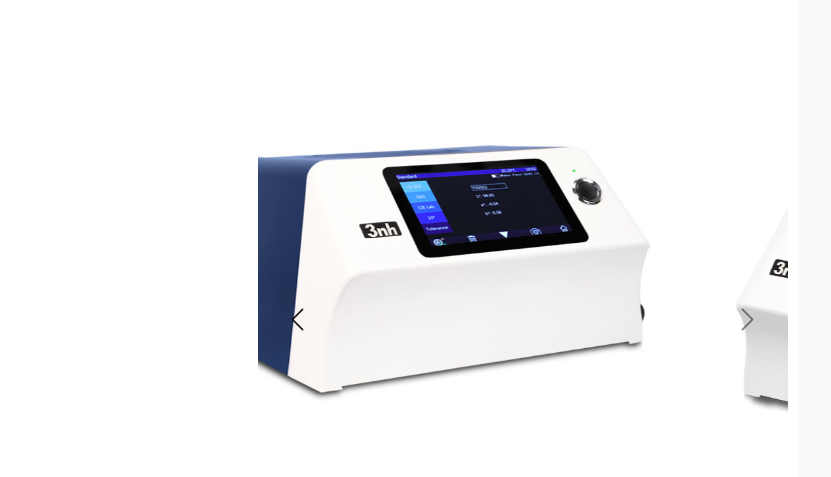
Accurate color measurement is essential wherever product appearance, consistency, and quality directly influence customer expectations. From automotive components and painted surfaces to plastics, textiles, cosmetics, paper, food packaging, and building materials, even small variations in color can affect the final appearance of a product. TS8216 Color Spectrophotometer provides a professional solution for organizations that need reliable, repeatable, and efficient color analysis throughout development, production, and quality control.
As a high-precision benchtop instrument, the TS8216 combines advanced spectral sensing technology, multiple measurement capabilities, an integrating sphere optical system, and intuitive operation. We can use it to establish color standards, compare production samples, support formulation work, monitor batch-to-batch consistency, and maintain objective color specifications across different stages of the supply chain.
What Is the TS8216 Color Spectrophotometer?
The TS8216 Color Spectrophotometer is a laboratory-grade color measurement instrument developed for demanding industrial and professional applications. It is designed to provide objective numerical information about the color characteristics of a sample instead of relying solely on visual inspection.
We can use spectral measurement to identify subtle differences that may be difficult for the human eye to recognize consistently. By converting color information into measurable data, the instrument helps quality-control teams establish clearer tolerances and make more confident decisions about whether a sample meets a defined specification.
The system is particularly valuable where color consistency must be maintained between raw materials, production batches, suppliers, manufacturing locations, and finished products.
TS8216 Benchtop Spectrophotometer for Laboratory Accuracy
The TS8216 Benchtop Spectrophotometer is designed for environments where measurement stability and precision are important. Its benchtop configuration provides a dedicated platform for laboratory and quality-control workflows while supporting measurements on a wide range of sample types.
Unlike basic portable color devices designed primarily for quick field checks, a benchtop spectrophotometer can provide a more comprehensive measurement environment. We can integrate the TS8216 into structured laboratory procedures where samples are repeatedly tested under controlled conditions.
This makes it suitable for research and development, color formulation, incoming material inspection, production verification, and final quality assurance.
Advanced Spectral Sensing Technology
At the heart of the TS8216 is advanced spectral sensing technology designed to capture detailed color information. The instrument uses a high-performance sensor system to analyze the spectral characteristics of samples with high sensitivity.
The supplied specifications highlight a 256-element linear CCD sensor, while the TS8216 color-measuring platform is also described as using advanced CMOS image-sensor technology. These technologies are intended to provide broad spectral response and sensitive color detection, supporting accurate analysis across demanding industrial applications.
By capturing detailed spectral information, we can obtain a more objective representation of a sample’s color than visual comparison alone can provide.
High Precision and Excellent Repeatability
Repeatability is one of the most important characteristics of any professional color measurement instrument. If the same sample is measured repeatedly, the results should remain highly consistent.
The TS8216 is designed around this principle, with specified repeatability performance reaching very low ΔE values. The product information indicates repeatability of ΔE*ab within 0.01 under the stated measurement conditions, while other supplied specifications cite ΔEab ≤0.08. The exact performance can depend on measurement configuration, aperture, sample characteristics, and operating conditions.
This level of consistency can help laboratories identify genuine color differences rather than measurement noise. We can therefore use the instrument more confidently when monitoring production tolerances and evaluating samples against established standards.
Reliable Inter-Instrument Agreement
Modern manufacturing frequently involves multiple measurement instruments. A color standard developed in one laboratory may need to be reproduced by another facility, supplier, or production location.
For this reason, inter-instrument agreement is extremely important. The TS8216 is specified with inter-instrument error controlled to approximately ΔE*ab ≤0.25.
Reliable agreement helps organizations create a more consistent color-management process. When instruments are properly maintained, calibrated, and operated according to appropriate procedures, measurement data can support communication between different departments and manufacturing partners.
Reflection and Transmission Measurement
One of the major advantages of the TS8216 is its ability to support both reflection and transmission measurements.
Reflection measurement is useful for opaque or surface-based materials such as:
- Painted components
- Plastics
- Textiles
- Leather
- Paper
- Coatings
- Ceramic surfaces
- Building materials
- Finished manufactured products
Transmission measurement is particularly useful when light passes through a sample, making it relevant for transparent, translucent, or semi-transparent materials.
Having both capabilities in one benchtop platform gives laboratories greater flexibility. We can select the appropriate measurement approach according to the optical characteristics of the material being evaluated.
D/8 Geometry for Professional Color Measurement
The TS8216 uses D/8 geometry, an important configuration for professional color measurement. The system supports SCI and SCE measurements, allowing laboratories to evaluate samples with different approaches to the influence of surface gloss.
SCI, or Specular Component Included, incorporates the specular reflection in the measurement. SCE, or Specular Component Excluded, removes the specular component to provide information that can be more closely associated with visual appearance under certain conditions.
Supporting both approaches allows us to obtain more useful information when working with materials where surface finish and gloss influence perceived color.
Multi-Aperture Design for Different Samples
Industrial laboratories rarely work with samples of exactly the same size, shape, or surface structure. A measurement system therefore needs sufficient flexibility to accommodate different sample types.
The TS8216 features a multi-aperture design, allowing us to select an appropriate measurement configuration for different samples. This is particularly useful when dealing with complex materials or samples whose dimensions and optical characteristics vary.
A flexible aperture system can make the instrument more practical for laboratories serving multiple departments or industries because the same platform can be adapted to different measurement requirements.
Industrial-Grade 7-Inch Touchscreen
Efficient laboratory equipment should not only provide accurate measurements; it should also be straightforward to operate.
The TS8216 incorporates an industrial-grade 7-inch high-definition touchscreen. This provides a dedicated interface through which users can access measurement functions, review information, and manage testing procedures.
A large touchscreen can be especially useful in busy quality-control environments where operators need to read measurement information quickly and navigate between different functions without relying on complicated external controls.
Digital Sample Identification and Measurement Records
Color management becomes much more powerful when measurement data can be connected with the sample being tested.
The TS8216 includes a digital label feature that can associate information such as device status, sample images, and measurement parameters with individual measurements. This provides additional context around the recorded result.
For quality-control teams, maintaining this information can make it easier to review previous measurements, compare samples, and organize laboratory records. It also supports a more structured approach to color-data management.
PC Software for Data Analysis and Management
Professional color measurement often requires more than a single numerical reading. Laboratories may need to compare multiple samples, organize measurement records, analyze trends, and manage color information over time.
The TS8216 can integrate with PC software for data analysis and management, extending its usefulness beyond the instrument’s touchscreen interface.
We can use connected software workflows to support more organized data handling, facilitate comparisons, and improve communication between laboratory and production teams. This can be particularly valuable for manufacturers processing large numbers of samples.
TS8216 for Color Formulation and Standard Development
Color formulation requires accurate information about the relationship between a target standard and a material or production sample.
The TS8216 can support the formulation process by providing objective measurements that help technicians evaluate color differences. Instead of depending entirely on visual judgment, we can use numerical data to understand how closely a formulated sample approaches a target.
The same principle applies when creating or verifying color standards. A clearly defined numerical reference can provide a stronger foundation for maintaining consistency throughout production.
Applications Across Multiple Industries
The versatility of the TS8216 makes it suitable for a broad range of industries where color accuracy matters.
· Automotive Manufacturing
Automotive manufacturers require consistent colors across painted body panels, plastic components, interior materials, and supplier-produced parts. Spectrophotometric measurement can help identify differences before components reach final assembly.
· Paints and Coatings
Paint manufacturers and coating suppliers can use precise color measurement during formulation, production, and batch verification. Consistent numerical data can help maintain target colors across different production runs.
· Plastics
Colorants, polymers, additives, and processing conditions can influence the final appearance of plastic products. The TS8216 can help manufacturers evaluate these variations objectively.
· Textiles and Apparel
Textile production often involves large quantities of material that must maintain consistent coloration. Spectrophotometric testing can support color approval, production monitoring, and supplier quality control.
· Cosmetics
Cosmetic products frequently depend on subtle color differences. Measurement can support the development and quality verification of products such as powders, creams, and other colored formulations.
· Paper and Packaging
Paper, packaging substrates, printed materials, and related products can benefit from consistent color measurement, particularly where brand colors must remain uniform.
· Building Materials
Manufacturers of construction and architectural materials can use color measurement to maintain consistency between batches and product ranges.
· Food and Beverage
Color can also be an important quality characteristic in food and beverage manufacturing. Objective measurement can complement established visual and laboratory quality-control procedures.
Why Choose a Benchtop Spectrophotometer for Color Control?
A benchtop system provides a dedicated environment for professional color measurement. We can establish repeatable laboratory procedures, use appropriate sample positioning, manage standards, and maintain structured measurement workflows.
The TS8216 combines this benchtop format with reflection and transmission capability, D/8 geometry, SCI/SCE measurement, multiple apertures, touchscreen operation, and computer-based data management.
Together, these features create a practical platform for organizations that need more than basic color checking.
Supporting Consistency Throughout the Supply Chain
Color problems can originate at many points in the manufacturing process. Raw materials may vary, suppliers may use different processes, or production conditions may change over time.
A standardized measurement process helps us establish objective checkpoints. Materials can be measured when received, formulations can be evaluated during development, production batches can be inspected, and finished products can be verified before shipment.
This approach helps transform color management from a subjective visual task into a measurable quality-control process.
Improving Laboratory Efficiency
Efficiency is another important consideration for modern laboratories. Operators may need to evaluate numerous samples every day while maintaining accurate records.
The TS8216’s touchscreen interface, rapid measurement capabilities, digital sample information, and PC connectivity can contribute to a more organized workflow. When measurement procedures are standardized, technicians can spend less time dealing with inconsistent manual processes and more time interpreting useful color information.
A Practical Solution for Modern Color Management
The value of a professional color spectrophotometer comes from more than its sensor or measurement geometry. The complete system must support accuracy, repeatability, flexibility, usability, and data management.
The TS8216 Benchtop Spectrophotometer brings these elements together in a single color measurement platform. With support for reflection and transmission testing, D/8 geometry, SCI/SCE measurements, multiple apertures, advanced spectral sensing, high repeatability, and software-based data management, it can serve as a central instrument for laboratory and industrial color-control processes.
Conclusion
Consistent color is an important part of product quality, brand identity, manufacturing efficiency, and customer satisfaction. As production environments become more demanding, objective color measurement provides an effective way to control variation and establish reliable quality standards.
The TS8216 Color Spectrophotometer is designed to meet these requirements with a combination of advanced sensing technology, precise measurement performance, flexible optical configurations, and practical laboratory features. Its support for reflection and transmission measurement allows us to work with a broad variety of materials, while D/8 geometry with SCI/SCE provides greater flexibility for professional color analysis.
For laboratories, manufacturers, research teams, and quality-control departments seeking a capable TS8216 Benchtop Spectrophotometer, the platform offers a comprehensive approach to color measurement, standard development, formulation, production monitoring, and quality assurance. By turning visual color differences into reliable measurement data, we can build stronger color-control procedures and maintain greater consistency from development through final production.